Indigenous Dispossession and Confinement on Reservations
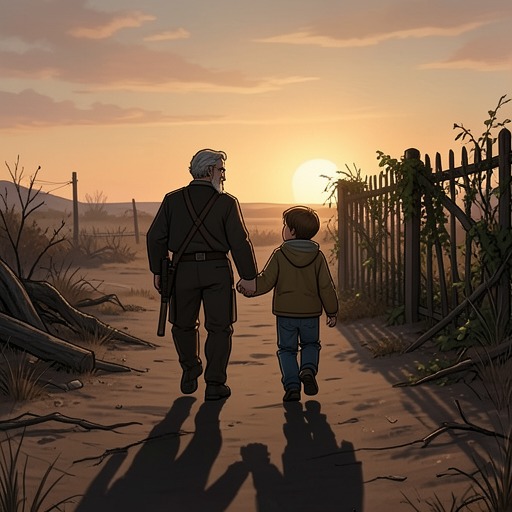
The Power of the Dog (Thomas Savage Edition)Indigenous Dispossession and Confinement on Reservations shape both the history of the valley and the journey of Edward Nappo and his son. The forced removal of Indigenous people is followed by rules limiting movement and access to resources; when father and son try to reach the land their family came from, exclusion is enforced again at a private gate. Their journey makes dispossession more than a historical backdrop: it is a continuing condition that governs where they may go and what they can reclaim.
Removal and Reservation Rule
The valley’s last Indigenous residents are herded from their lands and sent to a reservation. The narration connects this expulsion to changing political and economic priorities: the government no longer pretends to honor treaties, land has become too valuable to bargain over, and white voters’ anger matters more to officials than the possibility of Indigenous resistance. The people leave in worn buggies and on old ponies. Their removal is thus described not as an agreement between equals but as an exercise of power backed by the state.
Johnny Gordon witnesses the departing families from the high seat of his Model-T motorcar. His thoughts turn to the reservation in southern Idaho, where Edward Nappo and his family live. The contrast between the valley they have lost and the place where they are made to settle places personal memory within a wider pattern: the family’s movement is directed by a decision made elsewhere, while their connection to the former home persists across generations.
The reservation’s rules regulate both movement and daily life. Liquor may not be sold or consumed; residents may not leave without a permit, granted only for a pressing reason; and firearms are forbidden. Meat is distributed through the government store, a rule used to justify the ban on guns. These restrictions are not simply administrative details. Together they limit travel, possession, and access to food, while the permit requirement makes departure dependent on official approval. The narration also notes the prejudice used to rationalize these controls, including the claim that Indigenous people cannot drink as well as white people.
Family Memory and the Decision to Return
Edward Nappo’s connection to the lost land is inherited as both family history and story. His father had been chief, and Edward would have been chief had the family not been sent to the reservation. Edward still sometimes thinks of himself in those terms and tells his son about the northern land that the boy has never seen. The stories preserve a relationship to place that removal has not erased, even though the son’s knowledge of it comes through his father rather than lived experience.
The family’s circumstances make that memory difficult to turn into action. During a severe winter, when the boy is twelve, the family faces hardship and their cow becomes ill. Edward and his son tend a fire while they wait for the animal to recover. Edward tells the boy more about the land, including the place where his grandfather was chief and where his grave lies. The boy proposes that they run away to see it. Jennie, Edward’s practical wife, doubts that they can make such a journey, especially with the sick cow. Edward nevertheless makes a private bargain with his son: if the cow lives, they will go.
When summer comes, Jennie prepares food for the trip, including canned beans, canned corned beef, and hard crackers. Edward does not report his plan to the Indian agent, partly because he expects that doing so might create trouble. Father and son leave before daybreak in a cart drawn by an old horse. Their preparations and departure show how even a visit to family land requires a journey undertaken without the permission demanded by the reservation system. The boy carries the hope that his family name may open a way forward; Edward is less certain that the people in the old land will honor that name.
A Journey Blocked at the Ranch
The trip is arduous and slow. The horse’s age means that Edward and his son usually walk, climbing into the cart when they see an automobile approaching. They travel toward the mountains and hope to see the place associated with the grandfather and his grave. After roughly two hundred miles, however, they come to a gate Edward does not remember. The gate marks a boundary they cannot cross by virtue of memory or ancestry alone.
Phil Burbank stands between them and the gate. His view of Indigenous people is shaped by contempt: he dismisses romantic interest in them, calls them lazy and thieving, and recalls complaints about hiring them for ranch work. He also recounts the removal to the reservation as a solution to problems white ranchers attributed to Indigenous workers and neighbors. His account converts prejudice into a justification for exclusion, treating the government’s expulsion as sensible and the people expelled as responsible for their own marginalization.
Edward tells Phil that his father was chief and asks, in effect, for room to continue. Phil says that he does not care who Edward’s father was and orders Edward and his son to turn back. Edward asks only for a short stay so the old horse can rest. Phil refuses. The exchange brings the larger history into a specific encounter: the family’s former standing and their present need do not outweigh Phil’s control of the ranch entrance. The land is nearby, but access to it is determined by those who now hold power over its boundaries.
Return and an Unequal Welcome
After the blocked journey, the cart is seen again near the ranch house. Rose Gordon Burbank notices Edward and his son traveling with the old horse and cart. George Burbank tells her that Phil had gone out to check on a rider and supposes that he turned the travelers back; he explains that Phil has never taken to Indigenous people, regardless of who they are. The episode confirms that Phil’s refusal is not merely a response to the horse’s condition or a practical concern about the gate. It belongs to his established hostility toward the people making the journey.
Rose runs after the cart in high heels and asks the travelers to stop. She explains that she had seen them earlier and would have come out to meet them if she had known Edward was the son of the chief. Edward asks whether she knew his father. Rose answers that her husband did, and says that they would be proud to have the travelers camp with them. Her offer sets a different response beside Phil’s rejection: George’s connection to Edward’s father, conveyed through Rose, permits recognition where Phil had dismissed Edward’s family history. The evidence establishes the invitation, not its outcome; even so, the contrast exposes how access and welcome depend on the decisions of particular people as well as on formal rules.
Narrative Significance
The account links state policy, private property, and inherited memory without treating them as interchangeable. Reservation regulations constrain departure through permits and limits on possessions; Phil’s gate turns private control of land into a further barrier; and Edward’s stories preserve a claim to a home that these restrictions cannot settle. His son’s wish to see the grandfather’s land gives that memory a future, while the journey’s obstruction shows the distance between remembering a place and being allowed to reach it.
The different responses of Phil and Rose also prevent the encounter from becoming a simple portrait of uniform white opinion. Phil repeats stereotypes and enforces exclusion; Rose recognizes Edward through his family connection and offers a place to camp. That offer does not reverse the removal or restore the land, but it reveals a limited possibility of hospitality within an unequal situation. The episode’s central force lies in this imbalance: Indigenous people retain names, kinship, and memories of their homeland, while the practical power to cross its boundaries rests with others.